Hadja Andrée Touré
Introduction
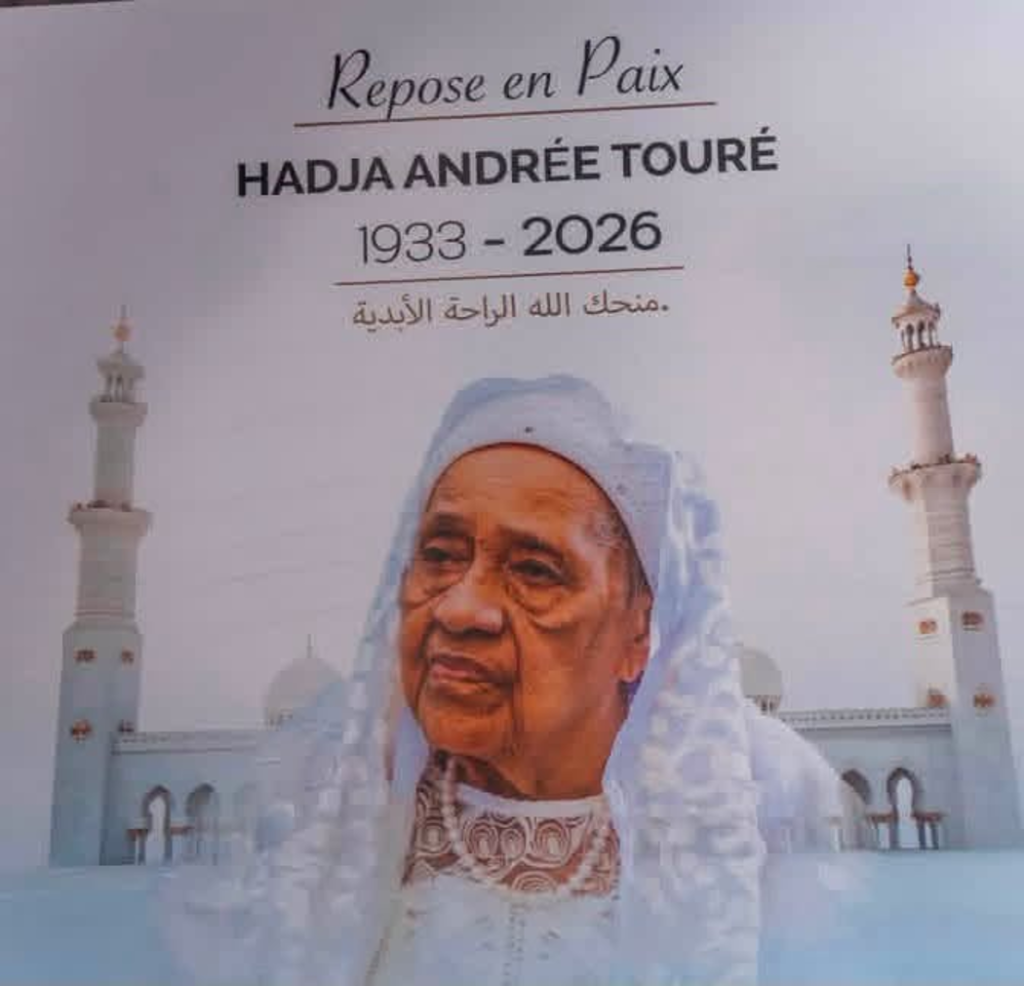
Hadja Andrée Touré, widow of President Ahmed Sékou Touré and the first woman to hold the title of First Lady of the Republic of Guinea, passed away on Wednesday, July 8, 2026, in Morocco, at the age of 93. Her life, marked by the splendor of power, the trials of exile, and a belated rehabilitation, remains inseparable from the history of independent Guinea. This is a look back at the life of a woman who, for more than half a century, embodied the living memory of Guinean independence.
Origins and Childhood
Born in 1934 in Kankan, Upper Guinea, Andrée Touré grew up in a mixed-heritage environment that would shape her identity for life. She was the daughter of a French military doctor, Dr. Paul-Marie Duplantier, and a Maninka woman named Kaïssa Kourouma. This dual Franco-Guinean heritage placed her, from an early age, at the crossroads of two worlds, at a time when colonization still deeply structured Guinean society.
Her father’s departure at the outbreak of the Second World War upset her childhood. Young Andrée was then entrusted to the family of her uncle, Mory Sinkoun Kaba, who raised her in Kankan. It was in this household that she grew up, far from her biological father, but surrounded by a Guinean family that passed on to her its cultural and social bearings.
An Education Shaped by the Colonial Context
Like many young girls of her generation from families in contact with the colonial administration, Andrée Touré benefited from schooling that was, at the time, a privilege. She earned her primary school certificate at the age of twelve, in 1946, before continuing her education at the Collège des jeunes filles de Conakry, run by the Sisters of Saint Joseph of Cluny.
This religious institution, known for the rigor of its teaching, allowed her to obtain the brevet élémentaire, a diploma that opened limited but real prospects for young Guinean women of the era. She later became secretary of the women’s association of the French Union, an experience that introduced her, while still young, to community involvement and public life — a few years before she met the man who would become the first president of independent Guinea.
Meeting Sékou Touré and the 1953 Marriage
It was precisely at her uncle Sinkoun Kaba’s home that young Andrée met Ahmed Sékou Touré, then a young Guinean trade unionist on the rise politically. Their union met with reluctance in certain influential circles of the time, notably because of the difference in social status between the two families. Neither social obstacles nor the reservations of certain relatives prevailed over this relationship — one arranged by the families, yet genuinely desired by the young couple.
The marriage was celebrated on June 18, 1953, at the great mosque of Kankan, according to Muslim rites, even though the young couple did not themselves attend the traditional religious ceremony. This union sealed a shared destiny that would soon merge with that of an entire nation marching toward independence. The couple had one son, Mohamed Touré, born March 12, 1961, who would later become a Guinean political figure in his own right.
First Lady of the Young Republic
When Guinea gained independence in October 1958, following the famous Guinean “No” in General de Gaulle’s referendum, Ahmed Sékou Touré became the country’s first president. Andrée Touré then took on, at his side, the unprecedented role of First Lady of the Republic of Guinea. She was the very first woman to officially hold this title in the country’s history.
During her husband’s twenty-six years in power, she chose discretion over media exposure, while still taking on an active social role. She converted to Islam and regularly represented her husband at official receptions. Her unwavering support served as a quiet but essential pillar during the turbulent years of building the young Guinean state.
Andrée Touré also accompanied her husband on numerous major international diplomatic trips. She was notably present at his side during meetings with prominent heads of state and government, including US President John F. Kennedy in Washington, Tunisian President Habib Bourguiba, Chinese leader Mao Zedong in Beijing, and Soviet leader Nikita Khrushchev in Moscow. These trips reflect the discreet but real diplomatic role she played alongside the Guinean head of state on the international stage of the Cold War.
After Sékou Touré: Arrest, Conviction, and Exile
The death of Ahmed Sékou Touré on March 26, 1984, following a failed heart procedure, marked a brutal turning point in Andrée Touré’s life. Just days after the president’s death, a coup overthrew the ruling regime. Andrée Touré and her son Mohamed were arrested, and their property was seized by the new authorities.
In 1987, Andrée Touré was sentenced to eight years of forced labor — a particularly harsh sentence for the woman who had been the discreet wife of the father of Guinean independence. She was finally released in early 1988, but forced to leave the country. A long period of exile then began, taking her successively to Morocco, Ivory Coast, and then Senegal.
Return to Guinea and Rehabilitation
It was not until 2000, more than a decade after her forced departure, that Andrée Touré was finally able to return to her native country. Back in Guinea, she devoted the following decades to defending and preserving the memory of her late husband, actively taking part in passing on Ahmed Sékou Touré’s political and historical legacy to younger generations of Guineans.
Her son, Mohamed Touré, was also appointed secretary general of the Guinean Democratic Party, the political party founded by his father, thereby continuing the family’s engagement in national political life.
A symbolic turning point came under the presidency of General Mamadi Doumbouya, who came to power following the September 2021 coup. Guinea’s current authorities carried out a form of official rehabilitation of Andrée Touré, a gesture widely praised as an act of historical justice, restoring the honor of the former First Lady and giving her back the place she deserved in the national collective memory.
The Publication of Her Memoirs
In 2023, at the age of 89, Hadja Andrée Touré published an autobiographical work with L’Harmattan Guinée titled Ma Vie auprès d’Ahmed Sékou Touré (“My Life Beside Ahmed Sékou Touré”). The book retraces the whole of her journey alongside her husband: the struggle for independence, their many diplomatic trips around the world, and their shared life away from the official spotlight.
This work stands as a valuable testimony to a pivotal and often controversial period in Guinean history, this time told through the intimate perspective of the woman who shared the head of state’s daily life. It also allowed Andrée Touré to speak publicly once again, nearly four decades after the tragic events of 1984, and to defend, in her own way, her husband’s political legacy.
Death and National Tribute
Hadja Andrée Touré passed away on Wednesday, July 8, 2026, in Morocco, where she had been staying to receive medical care. News of her death was confirmed by a source close to the family, while no date had yet been set, in the hours following the announcement, for the repatriation of her remains to Guinea.
The death of the former First Lady immediately triggered a wave of official tributes. The chairman of the High Authority for Communication, Boubacar Yacine Diallo, paid tribute to the memory of a “towering figure” in Guinean national history, emphasizing the dignity and resilience she showed throughout her life, including in the face of the injustice of her imprisonment. He also highlighted her quiet social commitment to vulnerable women and children, as well as the act of rehabilitation carried out under the presidency of General Mamadi Doumbouya.
On the protocol front, Guinean authorities responded swiftly. President Mamadi Doumbouya dispatched, on the very day the death was announced, a large government and military delegation to the Cases Bellevue in Conakry, where the deceased’s family was receiving condolences. The delegation was led by the Minister Director of the Presidential Cabinet, Djiba Diakité, and the Minister Secretary General of the Presidency, General Amara Camara, accompanied by the national gendarmerie’s top commander, General Balla Samoura.
It was the Minister of Planning, International Cooperation and Development, Ismaël Nabé, who delivered the head of state’s official message to the grieving family, assuring them that the entire funeral proceedings would be covered by the Guinean government, given the national character of this period of mourning. This direct involvement by the presidency confirms that a funeral befitting her historic standing will be organized for the woman who was, for twenty-six years, First Lady of the Republic of Guinea.
Conclusion
The life of Hadja Andrée Touré remains inseparable from that of Ahmed Sékou Touré and from the turbulent history of independent Guinea. Her journey — between the splendor of power, the pain of exile, and belated recognition — illustrates the challenges faced by many women of her generation, torn between a traditional role and a longing for emancipation and public recognition.
A privileged witness to a period of Guinean history that was both glorious and turbulent, Andrée Touré managed, until the end of her life, to preserve her husband’s memory and contribute to a deeper understanding of that pivotal era. Her death, on July 8, 2026, marks the end of a generation of direct witnesses to Guinean independence, but her legacy — now recorded in the memoirs she published in 2023 — will continue to shed light for future generations on this essential chapter of Guinea’s history.